What Is Geocoding?
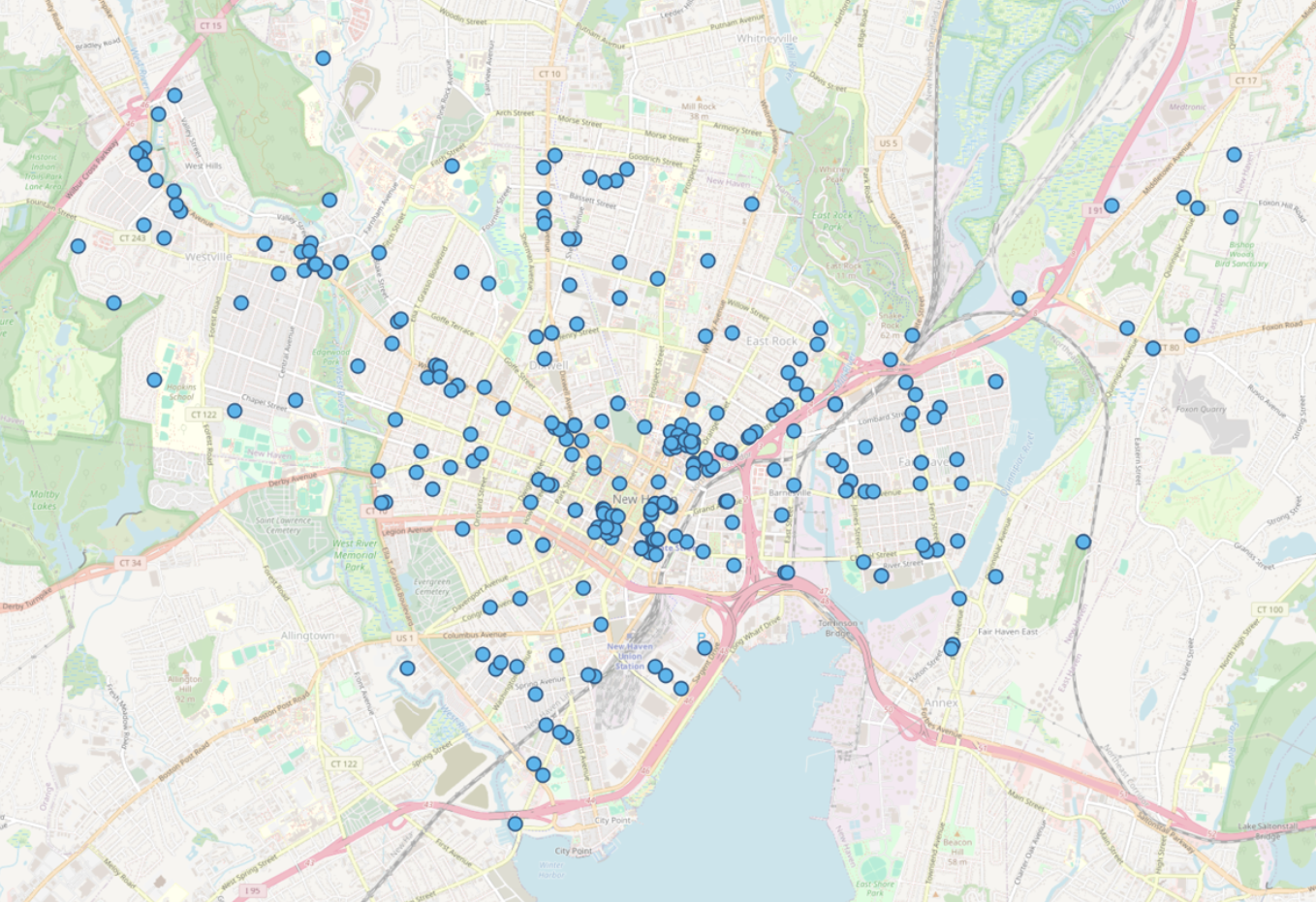
Geocoding is the process of converting textual information (addresses) into geographic coordinates that can be plotted on a map. It is a fundamental GIS operation, transforming everyday place descriptions into analyzable data.
At its core, geocoding works by matching an input address against references in a database. For example, “Yale University, New Haven, CT,” would return coordinate values for latitude and longitude, which can be represented as a single point on a map.
Geocoding has wide applications across industry and research:
- Epidemiology: tracking disease clusters, examining environmental exposure to pollutants
- Urban planning: identifying gaps in public transportation, managing public utilities
- Public policy: visualizing inequalities in housing and other resources, identifying food deserts
- Criminal Justice and Law: analyzing crime incidence and law enforcement responses
This lesson includes tutorials for geocoding in ArcGIS and QGIS, the most common GIS softwares.


